
Executive Summary
Implementing an in-house road repair program involves evaluating current equipment and crew capability, training crews on the simple processes of asphalt milling and road reclamation, and assessing current road repair needs. In-house asphalt milling and road reclamation allow public works departments to better manage their own road maintenance, saving time and money.
In-House Road Maintenance Checklist: Is Your Municipal Crew Ready?
- Do you have a host vehicle (compact track loader, backhoe, or loader), and do you know its model number, and ideally, gross vehicle weight? This will help you determine which milling machine / road reclaimer is compatible with your current equipment.
- What road repair method(s) fits your road conditions? Knowing what you need to accomplish, whether it is surface milling, full-depth reclamation, or both, will help you determine what equipment makes sense for your team.
- What will your material handling needs be? Spoiler alert: the simple full-depth reclamation process eliminates or greatly reduces hauling asphalt chunks or millings out and hauling new aggregate material in.
- Can your city afford an asphalt milling or road reclaimer attachment? The savings municipalities achieve from doing in-house road work often pay for the machine in as little as one project. Here’s the real question: can your city afford not to purchase an asphalt milling machine or road reclaimer attachment?
What equipment could you need for in-house road repairs?
In-house road repairs require a few key pieces of equipment:
- A road reclaimer or asphalt milling machine
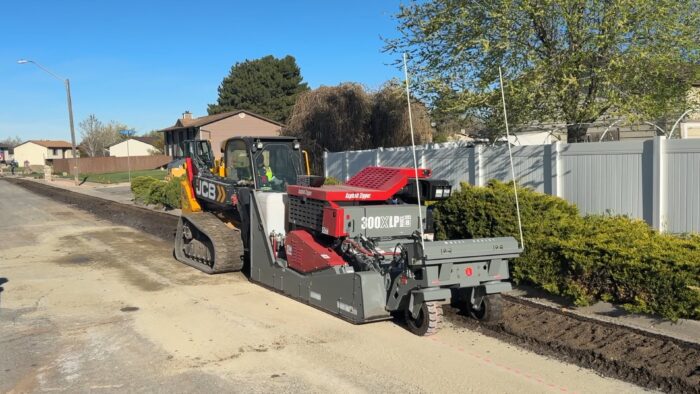
- A host vehicle (compact track loader, backhoe, or loader) *See graph below for Asphalt Zipper host vehicle requirements.
- A way to grade and smooth repaired areas prior to compaction. This could be as simple as back blading with a compact track loader or backhoe up to a full sized grader to shape the reclaimed road.
- A water source for full-depth reclamation projects to achieve maximum compaction and binding of the mixture of reclaimed asphalt product (RAP) and road base.
- A roller or compaction method to adequately compact the road and prepare it for paving
- A paver, although many municipalities opt to contract out this portion of the project. You can also do smaller patches with simple dumping and shoveling.
*Host Vehicle Requirements for Asphalt Zipper® Road Reclaimers
| Asphalt Zipper Model | Compatible Host Vehicle Type | Example Host Vehicle Model |
| AZ 720Xi Wheel Assist | Medium Large Loader | CAT 938 or similar |
| AZ 480Xi Wheel Assist | Medium Small Loader | CAT 926 or similar |
| AZ 420Xi Wheel Assist | Small Backhoe | CASE 580, Deere 310, or similar |
| 320 / 420 XLP | Compact Track Loader (CTL) | High-flow CTL with GVW of 10,000 lbs or greater |
What is your road repair crew’s skill level and training needs?
This can be surprisingly simple. Your operators just need an understanding of how to control depth and adjust material graduation, and how grinding depth affects production and speed. Once your crew gets some basic training, you are ready to get started.
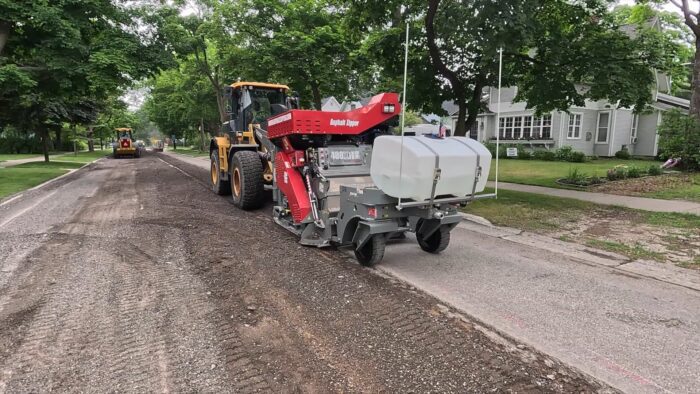
This may seem daunting, but a road reclaimer attachment is surprisingly easy to operate and includes direct factory training and customer support. Jared Wehry, Point Township, PA Roadmaster, and his 3-man crew had very little road repair experience prior to beginning in-house full-depth reclamation. After repairing a 1000-foot road for $40K instead of the $200K contractor quote, he reports, “If a cop, a cook, and a musician can do it, anyone can do it.” See full project here.
What road repair method fits your road conditions?
If your road has surface damage only a few inches deep, an asphalt milling attachment to remove the affected asphalt may be enough. If the road base is compromised, surface repairs will only be temporary. Full-depth reclamation helps stabilize the road base and leads to long-term repairs. Finding an asphalt milling machine that does both gives road departments the flexibility to determine the best road repair method based on the project need.
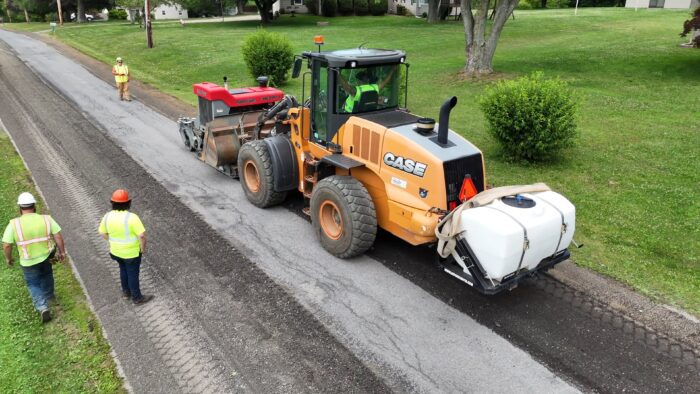
Point Township needed road base stabilization, but some projects require only surface milling. For example, Traverse City, MI recently expanded their milling and paving capabilities, saving money on their city’s road repair budget. Previous to owning an asphalt milling attachment, they found themselves patching potholes on the same city block all winter long.
With an asphalt miller, they were able to quickly mill out several inches of the road surface. After re-paving, they are very pleased with the results. Chris Weber, Director of Mobility Infrastructure, also reports, “We are also excited to look at some of its (Asphalt Zipper Machine) stabilization aspects, especially in some of our alleys.” See the full project here.
What will your road project material handling needs be?
Full-depth reclamation pulverizes and blends the reclaimed road surface with the existing road base. This recycling method significantly reduces and often eliminates the need for hauling and disposal. This means fewer steps and less equipment.
Since full-depth reclamation helps stabilize the road base, it also leads to substantially longer-lasting roads. Any excess reclaimed material can be reused as road base material or trench backfill on other projects.
Can your city afford an asphalt milling machine?
Savings on contractor fees along with the increased production capabilities allow communities of all sizes to easily afford asphalt milling and road reclaimer attachments. Many communities also elect to spread the equipment cost into five annual payments, making it even more affordable.
With tight budgets, it may seem difficult to justify an asphalt milling machine purchase, particularly to elected officials and taxpayers. However, asphalt reclaimer and milling machine attachments allow cities to repair more roads on the same budget, and the repairs last significantly longer.
A: Municipalities generally need a road reclaimer or milling machine attachment, a host vehicle (loader, backhoe, or compact track loader), a way to grade, a compaction roller, and a water source to help achieve maximum compaction density.
A: Yes. By utilizing a reclaimer machine that attaches to existing loaders or backhoes, municipalities can greatly reduce or eliminate contractor fees and save 70% or more on their road repair projects.
A: Surface milling removes top pavement layers for recycling, while full-depth reclamation pulverizes and blends existing asphalt directly into the underlying road base, helping to stabilize it without requiring off-site material hauling or disposal.
Conclusion
In-house road repairs are easier and far more affordable than many municipalities think. By utilizing the equipment they already own and adding a road reclaimer / asphalt milling machine attachment, they can take control of their budgets and project timelines.