Executive Summary
Asphalt milling machines and attachments come in a wide variety of sizes. These include hydraulic skid steer mill heads, portable self-powered asphalt milling attachments, and self-contained milling machines with load out belts. Choosing the best asphalt milling solution depends on project size, production, and power needs as well as equipment transportation logistics.
Introduction
As any municipal road crew or public works director will tell you, balancing extensive road rehabilitation needs with less-than-adequate budgets is a constant challenge. Do you have more miles of road that need rehabilitation than budget dollars to complete them? The equipment you choose has a direct impact on your productivity. So what matters most when choosing an asphalt milling machine?
The term asphalt milling machine covers a wide range of equipment. This guide includes practical advice on matching equipment to project size and scope. It also addresses engine power needs, host vehicles for attachments, and transportation logistics.
Specifically, the right asphalt reclaimer or milling machine can empower a municipality to complete more road repair projects in house. What used to take days can now be done in as little as a few hours, allowing communities to repair more roads with the same budget.
What is an Asphalt Milling Machine?
The term asphalt milling machine covers a wide range of equipment options. Asphalt milling machines pulverize asphalt into reclaimed asphalt pavement (RAP) at specified depths using a rotating drum and cutting teeth or bits. This material can be reusable as road base, trench backfill, or shoulder material.
Within this functionality, there are three general equipment categories:
- Skid steer cold planer attachments that rely on host vehicle hydraulics for power
- Asphalt grinder and road reclaimer attachments with powerful engines
- Large self-propelled cold planers or milling machines
Essentially, all asphalt milling machines pulverize asphalt into reclaimed asphalt pavement (RAP). Choosing the right asphalt milling machine can enable a municipality to complete more projects with the same budget.
Why Does Equipment Size Matter on Road Rehabilitation Projects?
Each type of milling machine has its ideal application, and understanding this will help you choose the best equipment for your road rehabilitation needs. The problem that some municipalities face is equipment that is either too large or too small for their project scope. Understanding what you need will help you avoid over-paying for a bigger piece of equipment than you require. It can also help avoid project delays caused by equipment that is too small for your project size.
A first-hand example of this is the City of Cedar Rapids, Iowa. They are currently in a multi-year in-house road rehabilitation project, replacing their sealcoat roads with hard surface asphalt. Previously, they were using skid steer mill heads to remove the sealcoat. It worked initially, but then the hydraulic motors on their skid steers started overheating and failing. In fact, in 2025 they spent $80,000 on skid steer repairs which in addition to the resulting equipment downtime cost them roughly $160,000.
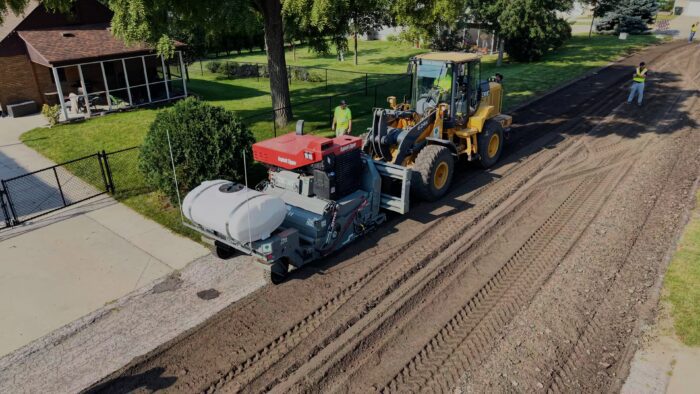
Public Works Streets Superintendent Brian McLeod quickly realized that they were using the wrong equipment for the scope of their project. They researched alternatives and discovered Asphalt Zipper’s 6-foot high-powered milling machine. Now they can complete entire projects that used to take 5-6 days in less than 2 days, milling up to 500 feet of street in less than 3 hours. And because the Asphalt Zipper is a portable attachment, it transports to the jobsite easily and is small enough for all residential streets. Now, Cedar Rapids is enjoying greater production and less down time with the right equipment for their project size.
Why Does Onboard Engine Power Matter for Municipal Fleets?
As we just learned from Cedar Rapids, an onboard engine is a huge game changer. Hydraulic skid steer milling attachments draw their power from the skid steer host’s hydraulic system. This significantly limits their speed and milling depth. Because of this, they are only suitable for smaller projects.
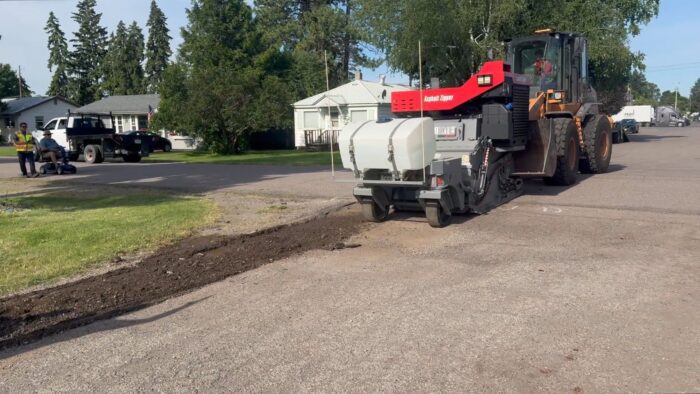
On the other hand, asphalt milling attachments with dedicated engines only require their host vehicle to push them forward. This puts minimal stress on the host equipment and provides significantly more powerful milling and reclamation capabilities. It also reduces unplanned downtime from repairs. Plus, some self-powered milling attachments have an optional Wheel Assist (WA) which supports much of the asphalt grinder weight with wheels on the front of the machine. This allows for use of and less strain on smaller host vehicles.
What Types of Host Vehicles Work with Portable Asphalt Grinders?
Asphalt grinding attachments quickly connect to a large range of backhoes, loaders, and compact track loaders. The size of your host vehicle will determine which machine it is best suited for. This table gives you an overview of Asphalt Zipper machines host vehicle requirements.
| Asphalt Zipper Model | Compatible Host Vehicle(s) | Example Host Vehicles | Cutting Width | Cutting Depth |
| 720Xi Wheel Assist | Medium Small Loader | CAT 926 or similar | 72″ / 1829 mm | 12″ / 305 mm |
| 480Xi Wheel Assist | Small Loader (215 hp) / Medium Small Loader (260 hp) | CASE 521F / CAT 926 or similar | 48″ / 1219 mm | 12″ / 305 mm |
| 420X Wheel Assist | Small Backhoe | CASE 580, Deere 310, or similar | 42″ / 1067 mm | 10″ / 254 mm |
| 300XLP / 420XLP | Compact Track Loader (CTL) (10,000 lbs or greater) | Cat 265, Case TR340B | 30″ / 762 mm and 42″ / 1067 mm | 10″ / 254 mm |
Compatibility notes assume a standard bucket; contact the manufacturer for an exact fit verification.
Comparing Asphalt Milling Machine Transport Requirements by Equipment Class
A final and often overlooked aspect of an equipment purchase is transportation.
- Most skid steers and mill heads are light enough to transport on a standard flatbed or equipment trailer pulled by a pickup truck.
- Asphalt milling attachments with dedicated engines typically weigh between 8,800 and 13,800 lbs. Asphalt Zipper offers a custom trailer for each machine model, allowing many standard work trucks to tow them to the jobsite. They can then connect in just minutes to their host vehicle.
- Large, self-propelled cold planers most often require an entire transportation team, with low-boy trailers, oversized load permits, and pilot cars. This makes these machines best suited for large highway projects.
FAQs
Q: What is the difference between a skid steer cold planer and an asphalt milling attachment with an onboard engine?
A: A skid steer milling attachment draws its power from the hydraulic system of the skid steer. This greatly limits its speed and grinding depth. An attachment with a dedicated engine only needs a host vehicle for forward propulsion, giving it much more speed and production.
Q: What are the host vehicle requirements for a portable asphalt milling attachment with an onboard engine?
A: Portable asphalt milling machine host vehicle requirements depend on the size of the grinder. They connect to a wide range of backhoes, loaders and compact track loaders that weigh over 10,000 lbs.
Q: Do I need a special permit to transport an Asphalt Zipper portable reclaimer attachment?
A: No. Asphalt Zipper machines on their own custom trailers range in weight from 9,000 lb to 30,000 lbs which generally does not require an over weight or over width permit. Large, self-propelled asphalt milling machines usually require additional permits and a lowboy to transport.
Q: Can I reuse asphalt millings?
A: Yes. Pulverized asphalt can be recycled as spec-comparable road base, utility trench backfill, shoulder material, or even used new asphalt.
Conclusion
Choosing the right asphalt milling equipment comes down to a few simple questions:
- How big is your project?
- Do you need an onboard engine, or is a hydraulically-powered attachment sufficient for the job?
- What host vehicles do you have access to?
- What are the transportation requirements for the asphalt milling machine you need?
Portable asphalt milling attachments have powerful, onboard engines and substantially higher production speeds and cutting depths than skid steer mill heads. Depending on the specific model, they are also compatible with a wide range of host vehicles, including compact track loaders. They are also easy to transport behind a standard work truck. For many projects, this combination of speed, host vehicle flexibility, and ease of transport, make them an ideal asphalt milling machine choice.