
Executive Summary
Asphalt removal can be the literal road block on a utility project, taking up valuable time and money. Choosing the best asphalt removal equipment and method has a direct impact on project speed, labor costs, and accurate bids. In this post we will compare the following methods and equipment:
- Saw Cutting equipment is inexpensive to purchase, but the process (cutting, chunking, loading, and hauling) is time consuming and labor intensive.
- Asphalt Grinder Attachments hit the sweet spot of power and production. With dedicated high-horsepower engines, they are easy to maneuver, have a high production speed, and feature cutting depths of up to 12-inches.
How do utility trenching equipment and methods compare?
Investing in the right asphalt grinding machine can actually lower your project cost and completion time, quickly paying for itself in the process. Sawcutting equipment might seem cheap initially, but all of the chunking, loading, hauling and disposal costs add up fast.
When you choose utility trenching equipment, it’s important to factor in much more than just the equipment cost.
Asphalt Removal Time Estimate
(Opening 400 Linear Feet, 3-foot Wide Trench, in 6-inch Deep Asphalt)
| Method | Production Speed |
| Saw-cutting (and chunking, loading, hauling and disposal) | 8+ Hours |
| Asphalt Grinding with Asphalt Zipper | ~ 30 Minutes |
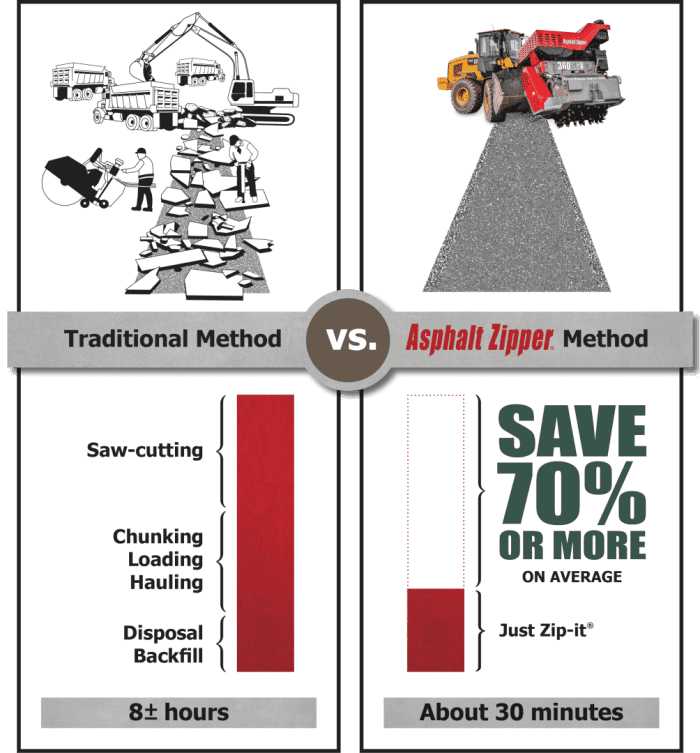
Asphalt Removal Cost Estimate
Asphalt removal costs vary based on a number of factors, but contractors report saving an average of $1,000 for every 100 feet of utility trench opened with an asphalt grinder. So if you are opening 400 linear feet of asphalt, you can expect to save approximately $4,000.
What equipment does sawcutting use?
- A walk-behind saw with diamond blades, also called a slab saw, features heavy wheeled frames and self-propelled drive systems. The operator guides the saw from behind, cutting the asphalt surface.
- A hydraulic breaker (hoe ram) or a mini excavator or backhoe with heavy teeth breaks the asphalt into chunks.
- A backhoe or loader loads the asphalt chunks onto dump trucks for hauling.
- A dump truck hauls the asphalt off site.
- A waste recycling facility (technically not equipment) accepts and processes asphalt.
What are the pros and cons of sawcutting instead of asphalt grinding?
Saw cutting asphalt has low up-front equipment costs. It creates precise cuts in sections of asphalt. On the flip side, its production rate is slow, and it creates non-reusable asphalt chunks which require asphalt disposal or recycling.
Sawcutting also includes 3 or 4 pieces of equipment and processes. This means multiple teams on the clock.
How does an asphalt grinding attachment impact utility bidding strategy?
An asphalt grinding attachment allows estimators to bid significantly lower on a utility trenching project for several reasons:
- Asphalt grinding attachments remove asphalt at an average cost of 29¢ per square foot. This is much lower than the average cost-per-linear-foot of sawcutting.
- Asphalt grinding eliminates or reduces hauling and asphalt disposal fees by reusing asphalt millings as trench backfill. One contractor calculates that they used to spend $900 per day per truck, just on hauling costs. That’s roughly $16K savings per month and $192K savings per year per truck.
- Asphalt grinding reduces labor and crew costs by combining multiple steps and teams. This allows a smaller crew to manage the asphalt grinding and removal processes.
- Asphalt grinding has significantly higher production than saw cutting, meaning significantly faster jobsite turnaround. An asphalt milling attachment can grind up to one thousand linear feet in an hour in 12-inch deep asphalt.
- Asphalt grinding also requires less handling of material. Often, the asphalt grindings can stay on the job site for use as trench backfill. If jobsite specs don’t allow this, crews can easily remove the millings (spec comparable base) as they excavate the trench, and reuse the millings on other projects.
- Asphalt grinding attachments require lower equipment transportation overhead. They don’t require lowboys or special permits. A work truck can pull the asphalt grinding attachments to the job site.
Frequently Asked Questions

A: An asphalt grinder attachment combines multiple trenching steps into one. This eliminates the cost and time of asphalt sawcutting, chunking, loading, hauling and disposal.
A: Asphalt grinding pulverizes the asphalt into spec comparable reusable material or trench backfill. It also creates a unique, scarified edge that bonds better with the new asphalt, resulting in 25% higher trench joint bond strength.
A: Estimators can submit lower, more competitive bids because of
Asphalt removal costs that average 29¢ per square foot.
Lower labor costs.
Reduced or eliminated asphalt hauling and disposal costs
Eliminating asphalt removal delays as you can now open an additional 100 feet of trench in as little as 5 minutes.
Conclusion
Upgrading your fleet with a portable asphalt grinding attachment boosts trenching speed and output by out-performing saw cutting in cost and production. This allows you to bid more competitively, win more projects, and be substantially more profitable.