
Utility contractors often install pipe, conduit, and service lines under city streets. Before crews place utility lines, they must open a utility trench through asphalt surfaces and remove the existing asphalt. This step affects cost, production speed, and schedule.
Project estimators usually compare three options for utility trenching: They can rent asphalt cutting equipment or hire a subcontractor to handle the full asphalt trenching job. They can also use an asphalt milling machine or asphalt grinder to open the trench directly.
Each method changes labor needs, equipment use, and overall cost. To see the differences, look at a common job example.
Project Example for Utility Trenching
Assume the job requires 1,000 feet of utility trenching in a city street. The trench measures 24 inches wide and cuts through 6 inches of pavement surface. This trench requires removing about 2,000 square feet of existing asphalt from the road surface.
Many municipal projects follow this same pattern. Crews cut through asphalt surfaces, remove pavement, install utility lines, and then restore the pavement surface.The estimator must choose the most cost-effective way to open the trench.
Renting Equipment and Subcontracting Asphalt Cutting
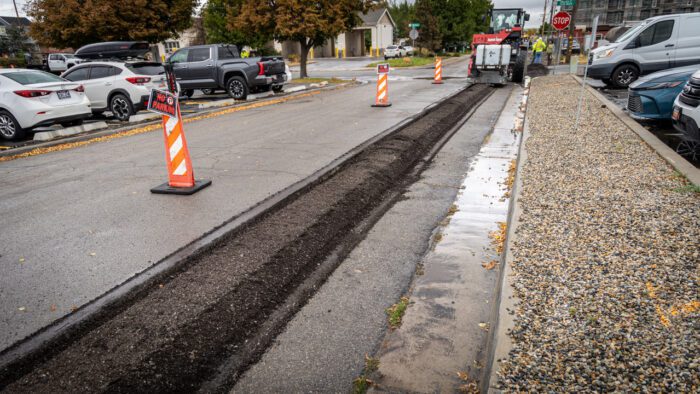
Many contractors rent trenchers and hire another company for saw cutting. The subcontractor performs asphalt cutting along both sides of the trench. Workers then break the pavement and haul the debris away.
This method requires several steps:
- A crew performs saw cutting along the trench path.
- Workers break and remove the existing asphalt in large chunks.
- Trucks haul the material away, often paying by the ton for the disposal fees which further increases costs.
- The trenching crew begins digging the utility trench.
Production usually reaches 200 to 400 feet per day depending on crew size, traffic control, and pavement thickness.
This approach works, but it creates coordination challenges. If the asphalt cutting crew arrives late, the trenching crew must wait. Idle crews increase cost and slow the project schedule. Estimators must include these risks in their bids.
Subcontracting the Entire Asphalt Trenching Job
Some contractors hire a subcontractor to handle the full asphalt trenching process. The subcontractor performs saw cutting, pavement removal, hauling and disposal, charging for each process.
This option simplifies crew management. The contractor does not need to schedule multiple crews. Production often improves slightly because experienced pavement crews focus on asphalt cutting and removal.
However, this option still carries schedule risk. If the subcontractor delays work, the contractor cannot start trench excavation. The entire project schedule shifts. Estimators often treat this method as reliable but expensive.
Using an Asphalt Milling Machine or Asphalt Grinder
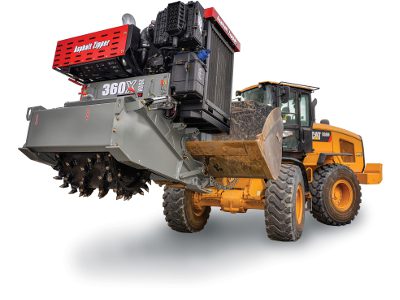
Another option uses an asphalt milling machine or asphalt grinding machine attached to a backhoe, loader or track skid steer. These machines remove asphalt through pavement grinding instead of breaking large chunks of asphalt. How It Works.
During asphalt grinding, a rotating drum with cutting teeth grind the pavement surface and create spec comparable recycled asphalt millings. The operator controls the trench depth using hydraulic depth control systems.
The operator sets the milling depth to match trench requirements. Accurate adjustable depth settings allow precise cuts while protecting nearby utility lines. Onboard water systems also control dust and keep neighbors happy.
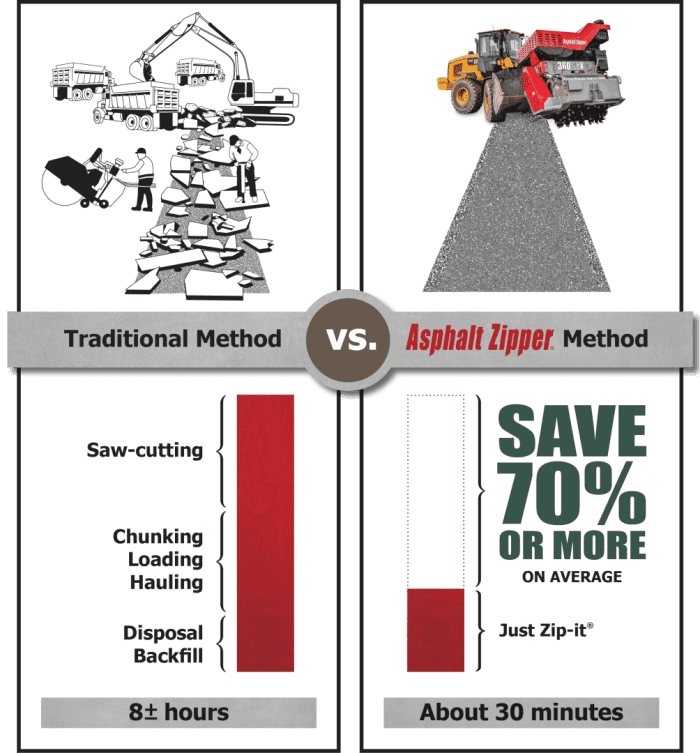
This process produces a clean milled surface along the trench path. Production improves dramatically. Crews can open about 400 plus feet of utility trench in roughly 30 minutes using a properly configured asphalt grinding machine.
At that speed, crews can open a 1,000-foot trench quickly and move directly to excavation. Because asphalt grinders grind pavement in place, the process eliminates separate asphalt cutting crews and reduces labor needs.
Production and Cost Considerations
For estimators, production speed drives cost.
Traditional saw cutting and pavement removal require several workers and steps. Crews cut asphalt, break pavement, load debris, and haul material away, often paying for disposal. Each step increases labor and equipment cost.
By comparison, asphalt grinding opens trench in one operation. Crews can usually use asphalt millings as trench backfill.
The asphalt milling machine grinds directly through the pavement surface and leaves a consistently ground up, ready for excavation.
Higher production reduces labor hours and shortens project schedules. This increases profitability and even early completion bonuses.
Faster trench opening also allows utility crews to begin installing pipe or conduit immediately.
Equipment Strategy Across Multiple Projects
Estimators rarely evaluate equipment for a single job. They consider how machines perform across many projects.
Contractors who perform frequent utility trenching can benefit from owning asphalt grinders or an asphalt milling machine attachment.
Regular use spreads equipment cost across many jobs. Higher utilization lowers the cost per foot of trenching.
Equipment ownership also improves scheduling flexibility. Crews no longer depend on subcontractor availability.
Operators maintain accurate milling depth, reliable depth control, and consistent adjustable depth settings when grinding through asphalt surfaces around utility lines.
The Estimator’s Bottom Line
Estimators must balance cost, production, and schedule risk when planning utility trenching work.
Traditional asphalt cutting and subcontracting methods still work for many projects. However, modern asphalt grinding machine technology allows crews to grind pavement faster and with fewer workers.
For contractors who perform regular asphalt trenching, the productivity of asphalt grinding and modern pavement milling tools can significantly lower trench opening costs over time.
Key Takeaways: Utility Trenching Through Asphalt
• Utility trenching requires cutting and removing asphalt surfaces before crews install pipe or conduit. This step strongly affects project cost, schedule, and crew productivity.
• Contractors often compare three methods: asphalt cutting with rented equipment, subcontracted trenching, or using an asphalt milling machine or asphalt grinder to open the trench directly.
• Traditional asphalt cutting requires multiple steps—saw cutting, breaking pavement, hauling debris, and paying disposal fees. These steps increase labor and slow production.
• Subcontracting the entire trench process can simplify scheduling but often raises total cost and still creates schedule risk if the subcontractor is delayed.
• Using an asphalt grinding machine or asphalt grinder allows crews to grind pavement in one operation instead of breaking it apart. This reduces labor and eliminates separate cutting crews.
• Asphalt grinding also produces reusable asphalt millings, which crews can often use as trench backfill. This can reduce material hauling and disposal costs.
• Production speed improves dramatically with an asphalt milling machine. Crews can open hundreds of feet of trench quickly, allowing excavation and utility installation to begin sooner.
• For contractors who perform frequent utility trenching, owning asphalt grinders can lower cost per foot by spreading equipment cost across multiple projects.
• Faster trench opening, fewer workers, and reduced hauling often make asphalt grinding one of the most efficient strategies for cutting trenches through asphalt pavement.