
When someone looks at purchasing an Asphalt Zipper, they usually have one or two applications in mind for it. What many people don’t realize is that these road reclaimer and asphalt grinding attachments have multiple potential uses. Taking advantage of your Asphalt Zipper’s versatility saves a substantial amount of time and money on a variety of projects.
We ran into an example of this working with a new 480Xi Wheel Assist owner. They had purchased their reclaimer for road repairs. While we were talking, we learned that before purchasing, they had completed a lengthy utility project, removing the asphalt with sawcutting. If they had known the Asphalt Zipper’s utility trenching capabilities, they could have saved a significant amount of time and money.
This post is to help Asphalt Zipper owners and prospective owners familiarize themselves with its many applications. These include full-depth reclamation, utility trenching, gravel road rehabilitation, chemical soil stabilization, precision surface milling, and even trail maintenance. By taking full advantage of your machine’s versatility, you can drive profitability and stretch budget dollars. Let’s take a look at some of our frequently asked questions to learn more.
What is the best way to remove asphalt on a utility trench?
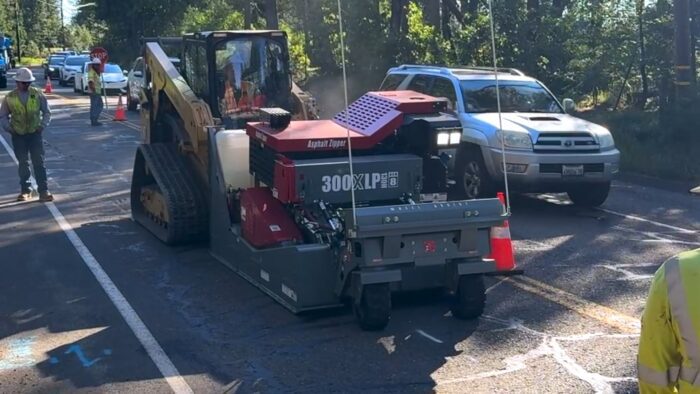
An asphalt grinding attachment is the best solution to streamline asphalt removal. It bypasses traditional saw-cutting, chunking, hauling, and asphalt disposal. Instead, the grinder simultaneously cuts a straight edge and pulverizes the asphalt. The resulting 1-inch minus asphalt grindings are much easier to haul away. Depending on project specs, this material can be used for trench backfill, in some cases eliminating the need for additional aggregate material. This reduces costs and drives profitability on a utility project.
Is a road reclaimer attachment a good solution for full-width roads?
Honestly, it depends on the attachment. Standard skid steer mill heads run on the host vehicle’s hydraulic system. This significantly reduces their grinding depth and speed.
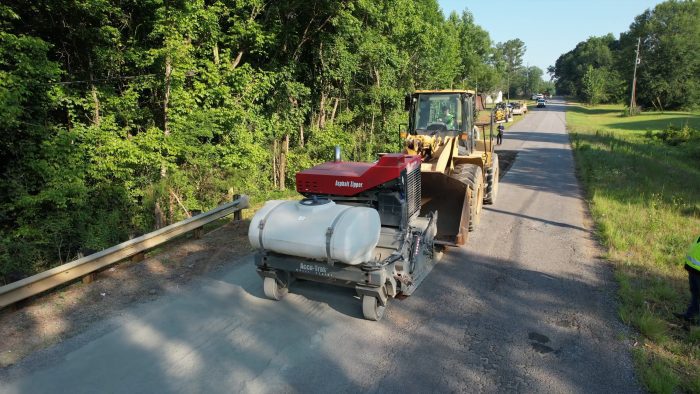
Although an attachment, an Asphalt Zipper has a dedicated engine that delivers continuous power to the cutterhead. Larger loader attachments feature 260 hp and cutting depths of up to 12 inches. These powerful machines can pulverize up to 2 miles of full-width road a day.
Our recent additions, the 300XLP and 420 XLP models, attach to compact track loaders (tracked skid steers). They have 130 hp and 173 hp engines respectively and cutting depths of up to 10 inches. This brings full-depth reclamation, road patching, and asphalt milling capabilities to organizations with smaller host vehicles.
In many instances, full-depth reclamation (FDR) delivers the benefits of a full road reconstruction, but at a fraction of the cost. It simultaneously pulverizes and blends the road surface with the base. This stabilizes the road base, helping to prevent future cracking and potholes.
FDR virtually eliminates the need to haul out old material, and depending on the method, can also limit or eliminate the need to haul in new material. This avoids vehicle emissions, asphalt disposal, and the production of new aggregate material, making it a sustainable, environmentally-friendly process.
What’s the best process for longer-lasting road patches?
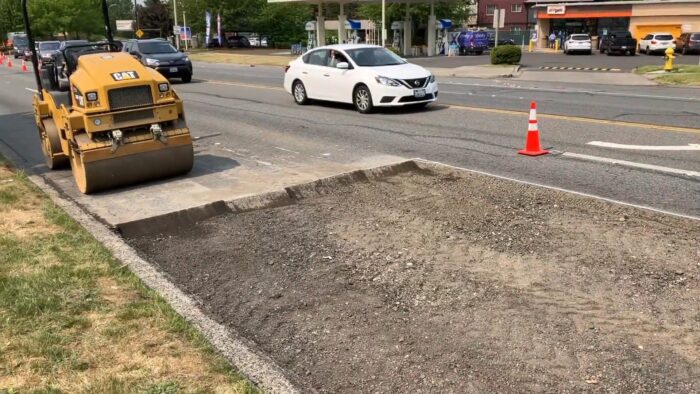
Full-depth reclamation is the best process for longer-lasting road patches. It addresses the root problem of failing pavement: base failure. Instead of putting on a bandaid with another temporary patch, FDR stabilizes the road base. This keeps those pesky potholes from returning.
A road reclaimer attachment is easier to maneuver and transport and less expensive than a self-contained reclaimer. This allows contractors and municipalities to perform FDR on even smaller patches, with big results.
What’s the best way to repair wheel ruts?
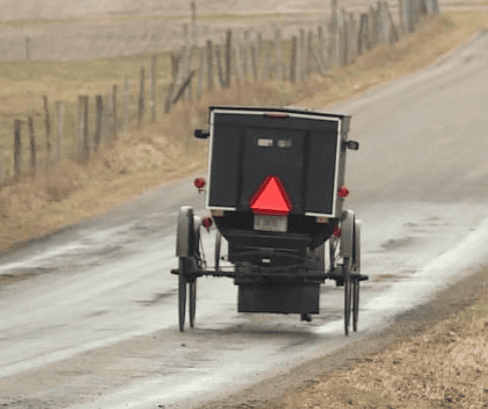
In Amish Country, buggies leave narrow, deep wheel ruts. Since these are generally rural communities, they don’t have large budgets for road repairs. Other communities may face similar problems with heavy, concentrated truck traffic
A road reclaimer attachment can mill the damaged asphalt out of the buggy ruts. A specialized blade on a loader pushes the millings out of the ruts, allowing for repaving.
Ideally, the road reclaimer pulverizes the asphalt and the base, creating added stability. This helps to prevent future rutting and failures.
Can I use my asphalt grinding attachment for surface milling?
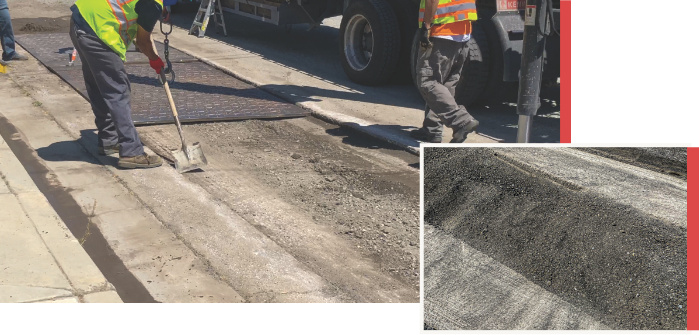
On a utility trenching project, crews can use an Asphalt Zipper for asphalt grinding and then use the same piece of equipment for milling t-cuts and trench plate recessing. This is made possible by stabilizing skis on each side of the machine and precise hydraulic cutting depth control.
What’s the best method for gravel road repairs?
Road reclamation on gravel roads is far superior to traditional blading. The reclaimer pulverizes the remaining gravel and mixes it with the road base, stabilizing it. This makes it much easier to reshape the road and correct drainage issues. For information on further extending the life of unpaved roads, see the soil stabilization section below.
What is the most cost-effective and time-saving method for soil stabilization?
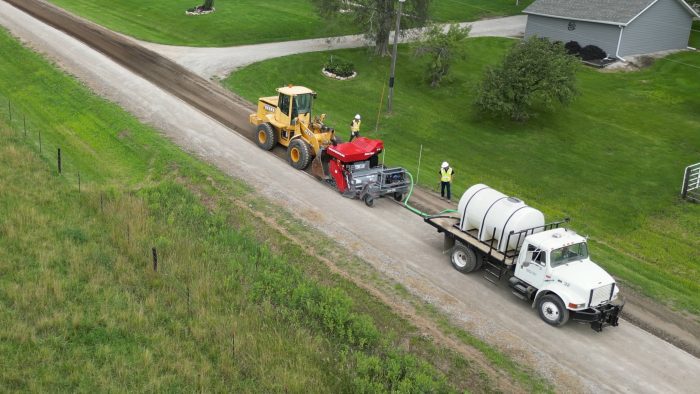
Your soil stabilization method depends on a variety of factors. These include the composition of the soil and your preferred stabilizer.
Asphalt Zipper’s patented Accu-Flow™ Metered Liquid Injection System is another option for soil stabilization. It injects liquid stabilizers directly into the pulverizing chamber. Crews can control the precise amount of stabilizer for superior results.
Regardless of which stabilizer you use, during pulverization, a road reclaimer even distributes the stabilizer into the road base. This saves a significant amount of time and money.
What’s the best way to maintain my paved trails and golf cart paths?
Paved trails can be a nightmare to maintain because large equipment can damage the surrounding landscape. A smaller asphalt milling attachment like the 300XLP or 420XLP connects to a compact track loader (track skid steer) with a significantly smaller equipment footprint. The paths are pulverized in place, eliminating the need for hauling out material. This process of full-depth reclamation also stabilizes the paths, decreasing future maintenance needs.
What’s the best equipment to use for parking lot repairs?
Arguably, an asphalt grinding attachment is the most important piece of equipment for parking lot repairs. Like with other forms of reclamation discussed here, it pulverizes the existing pavement and blends it with the base. After grading, this corrects drainage and slope issues. This also limits or eliminates the amount of material that needs to be hauled away.
A road reclaimer attachment is highly maneuverable, especially models with remote control wheels. This allows it to grind right up to the edge of lightpoles, landscape islands, and curbs.
Is there a road reclaimer that will work for alleyway repairs?
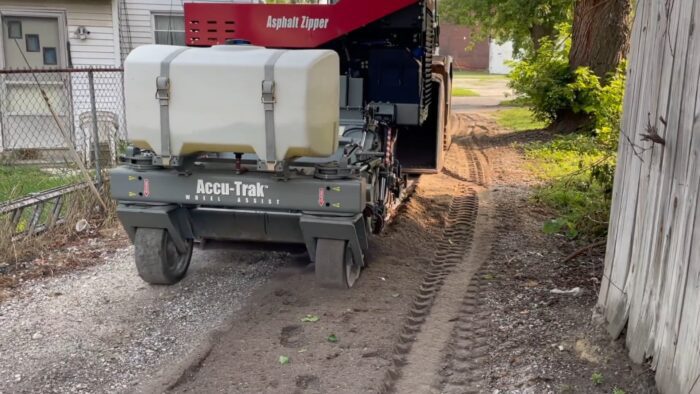
The Asphalt Zipper is a great solution for narrow alleyways because it has higher power and speed coupled with a smaller size. Simply put, it navigates through tight areas that stop larger equipment. It also reuses pavement on site, eliminating the need to haul it away. This streamlines the process and avoids disrupting neighborhoods for extended lengths of time.
Conclusion
Maximize your investment and make sure you are using your Asphalt Zipper to its full potential. Granted, certain machines are engineered with specific applications in mind, but it’s possible to use the same piece of equipment for multiple projects. Whether you call it an asphalt grinder, a road reclaimer, or a utility trencher, making sure you are using your piece of equipment to its full advantage will keep your projects on time and on budget.